Research
Introduction of research areas in Ito Lab;
Research area 1: Hydrogels for medical uses
Research area 2: Particles for medical uses: from nano to micro
Research area 3: Application to disease treatments
**************************************************************
Research area1:Hydrogels for medical uses
Injectable hydrogels are highly anticipated for use in minimally invasive
treatments. Using natural polysaccharides and proteins as backbone, we
fabricated in situ hydrogels cross-linked via biocompatible chemical reactions.
Since hydrogels are easy to handle, they are anticipated for use in various
areas, such as scaffolds for tissue regeneration, drug carriers, adhesion
barriers, hemostatic agents and many more.
Hyaluronic acid is commonly used as a polymer backbone due to its high
biocompatibility, and is important in cosmetic products, contact lens and
many other health care products. Dextran, cellulose and starch derivatives,
ionically cross-linkable alginate, positively charged chitosan, cell adhesive
collagen and gelatin, keratin are other examples of polymer backbones.

Since natural polymers are limited in design flexibility, synthetic polymers
are important to biomaterials as well. With progress in techniques for
polymer synthesis, dendritic polymers have become popular in industry.
With merits like low viscosity and easy surface modifications, they are
gaining popularity as foam and paper coating materials. In our lab, we
synthesized a novel nano-sized star polymer using chemically modified polymers
as building units for future application to medically used hydrogels, as
well as to colloidal dispersion system.

Other than fabrication, we also research on application process of biomaterials.
The structure and functions of biomaterials are heavily dependent on both
the starting material and process. As such, chemical engineering plays
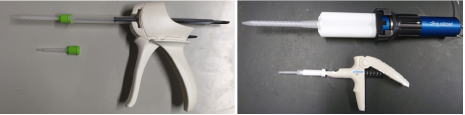
an important role. We are examining the gelation process using static mixers
and atomizers as methods of application.
Research area2: Particles for medical uses: from nano to micro
We are synthesizing fine particles for various medical uses. Other than
material composition, the size, shape and morphology are also important
in determining the functions of the fine particles.
Particles of nano-order size are called nanoparticles, and they exhibit
properties not found in bulk objects. For example, silicon nanoparticles
used in semiconductors show fluorescence, gold nanoparticles are colored
red with surface plasmon. Making use of these features, we are developing
nanoparticles for imaging and drug delivery carriers.

Also, we are developing anti-cancer drug-incorporated hyaluronic acid
nanogels that are spontaneously formed thorough metal coordination. Their
sizes range from 10nm to hundred nm, lying in between the size of nano
particles and micro particles. We aim to achieve effective drug delivery
by making use of cell-ECM adhesion and ECM turnover.

Micro particles are used as drug carriers via intramuscular injection,
and drug-eluting beads for embolization. Our lab focuses on the SPG membrane
emulsion technique for fabrication of highly uniform micro-particles. In
our lab, we are developing hemoglobin encapsulated oxygen carriers (artificial
red blood cell), and drug-drug-eluting beads for embolism.
Artificial oxygen carriers prepared by membrane emulsification range from
1-20um in diameter, while those synthesized by atomizers are about 150um
in diameter. As shown below, using functionalized ionically cross-linked
polymers, we are developing cell-encapsulating microcapsules for use in
artificial endocrine pancreas.

Research area3:Application to disease treatments
We are collaborating with the University Hospital and off-campus medical
institutions to utilize hydrogels and micro-particles in treatments of
diseases.
Regenerative medicine and tissue engineering
The concept of tissue engineering was proposed by a group of researchers
at MIT/MGH in the 1990s. By controlling the interaction of cells, scaffolds
and humoral factors, generation of artificial tissues was thought to be
possible. Injectable hydrogels and microcapsules are examples of scaffold
materials. In our lab, with a focus on bone and islet regeneration, we
look at differentiation of cell encapsulated in hydrogels, functional expression
through transplants, and angiogenesis.

Drug delivery system
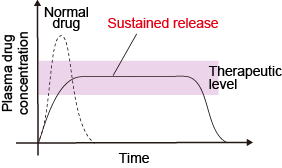
DDS refers to the technique of delivering the minimum required amount of drugs to a targeted location, at a targeting timing. One fundamental concept of DDS is sustained drug release. Drug concentrations above the limit will increase side-effects, whereas drug concentrations within the limit will not result. By maintaining the desired drug concentration range over long periods of time, not only will side effects and dosage be minimized, QOL improvements can be expected. We are researching on DDS for localized administration to peritoneal dissemination of gastric cancer, mesothelioma, and liver cirrhosis.
Tissue adhesion barriers and hemostatic materials
Adhesions of peritoneal organs to neighboring organs, or peritoneal membrane
after abdominal or laparoscopic surgeries, is commonly known as peritoneal
tissue adhesion. The repeated resection of the liver in hepatectomies give
rise to high occurrence of adhesion formation. This greatly reduces the
safety of surgeries, as well as lengthens surgery time. Taking advantage
of the merits of injectable hydrogels, we seek to fabricate novel adhesion
barriers possible for laparoscopic use.
Hemostasis is critical during surgical procedures. Since most available hemostats are composed of fibrin sealants and collagen-based materials, we are researching on fabrication of effective hemostats using materials not derived from the blood.
These medical devices are key to minimally invasive treatments, and indispensable to safe clinical practices.
|